
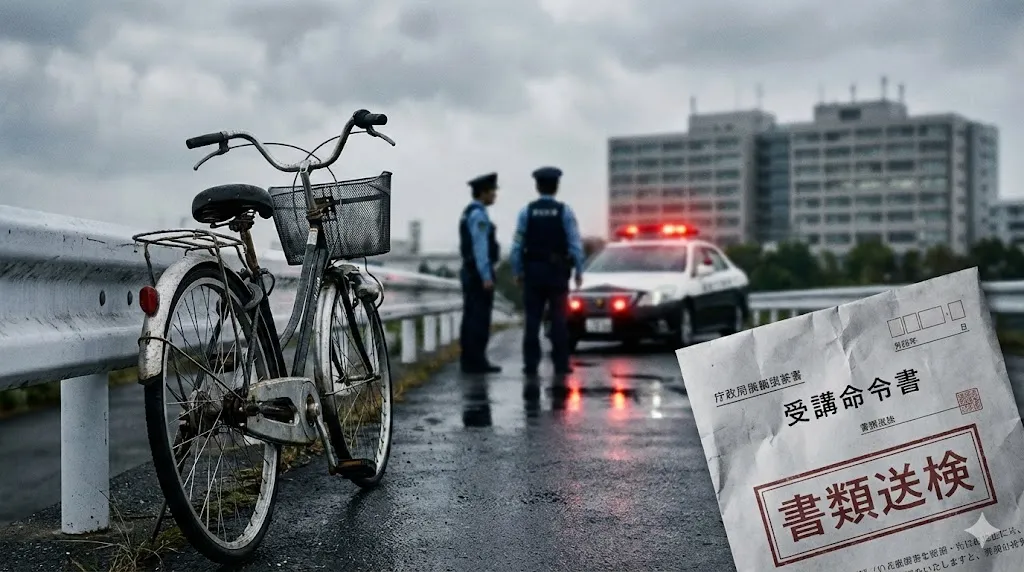

On February 12, 2026, the Osaka Prefectural Police referred a 40-year-old male office worker from Joto Ward, Osaka City, to prosecutors on suspicion of violating the Road Traffic Act for repeatedly ignoring orders to attend a “Bicycle Driver Safety Course.” This is the first case of a crackdown in Japan since the system began in 2015. We have entered an era where the lax perception of “It’s just a bicycle violation…” leads to direct demands at the workplace, criminal penalties, and the irreversible social loss of a “criminal record.” In this article, using this latest case as a lesson, we will objectively explain self-defense measures to ensure we do not become “perpetrators” or “ex-convicts.”
Principle: If you do not follow the safety course order from the Public Safety Commission, you will be subject to a “fine of up to 50,000 yen (criminal penalty)” based on Article 120, Paragraph 1, Item 17 of the Road Traffic Act, and a criminal record will be logged.
Exception: A grace period may be granted if there is a justifiable reason. However, in this case, the behavior was judged as malicious due to “14 reservation cancellations” and “ignoring over 50 reminders, including workplace visits,” leading to the criminal referral. The best defense is, first and foremost, “not to commit violations at a level that triggers an order.”
1. Failure to Attend the Bicycle Driver Safety Course Leads to Criminal Penalties
 生活リスクポイント
The Bicycle Driver Safety Course is not just a “traffic safety class.” It is an “administrative order” issued by the Prefectural Public Safety Commission based on Article 108-3-4 of the Road Traffic Act. This order is legally binding, and refusing it without a justifiable reason constitutes a violation of the law.
It is noteworthy that what is imposed is a “fine (criminal penalty),” not an “administrative fine (civil penalty).” Once finalized, it results in a criminal record. Even with a bicycle, you must recognize that there are stages where legally it will not be dismissed as a “minor mistake.”
Interpretation of Penal Provisions in the Road Traffic Act
Article 120, Paragraph 1, Item 17 of the Road Traffic Act explicitly states the penalty for “those who have not followed the order of the Public Safety Commission under the provisions of Article 108-3-4.” Ignoring a bicycle safety course order has extremely powerful legal enforcement power, making it an immediate subject for criminal proceedings.
2. Why Was This the First Criminal Referral in Japan? Reality Seen from the Osaka Case
 ミントちゃん
The subject, a 40-year-old male office worker from Joto Ward, Osaka City, received a safety course order in October 2023 for repeated dangerous acts such as ignoring traffic signals. Because he continued to ignore it even though he should have attended within the deadline from late July to late October 2025, it led to the first criminal referral in Japan.
Points Judged as “Malicious” by Investigative Authorities
The deciding factor for the criminal referral in this case was not just non-attendance, but the “clear refusal” seen in the following process:
- Routine Reservation Cancellations: He repeatedly made and canceled reservations a total of 14 times in an attempt to evade the course.
- Workplace Visit Reminders: In addition to over 50 phone calls, the police also conducted visits to his workplace. This completely blocked any excuses like “I didn’t know.”
The fact that police reminders reach as far as the workplace becomes a fatal social risk for an employee. The naive thought that “as long as I make a reservation, it’ll be fine” is powerless against the persistence of the authorities.
3. Invoking “Orders” Without Realizing! Details of the 16 Types of Dangerous Acts
生活リスクポイントThe “dangerous acts” subject to the Bicycle Driver Safety Course are the following 16 types defined by the Road Traffic Act. These are not just “manners” but are counted as clear “legal violations.”
| No. | Name of Dangerous Act (Article) | Specific Example / Risk |
|---|---|---|
| 1 | Ignoring Traffic Signals (Art. 7) | Ignoring red lights. Includes ignoring pedestrian signals. |
| 2 | Violation of Traffic Prohibition (Art. 8) | Driving while ignoring road signs such as “No Entry for Vehicles.” |
| 3 | Pedestrian Road Violation (Art. 63-4) | Obstruction of pedestrians on pedestrian roads, or failing to slow down. |
| 4 | Traffic Lane Violation (Art. 17) | Cycling on the right side of the road (Wrong-way). Violation of the duty to cycle on the left. |
| 5 | Side Strip Traffic Violation (Art. 17-3) | Obstructing pedestrian passage on a side strip or cycling in the wrong direction. |
| 6 | Entering Closed Railway Crossings (Art. 33) | Entering when the barrier is down or starting to descend. |
| 7 | Violation of Duty for Safe Passage at Intersections (Art. 36) | Obstruction of vehicles going straight when turning right at an intersection. |
| 8 | Obstruction of Priority Vehicles at Intersections (Art. 37) | Obstruction of vehicles traveling on a priority road. |
| 9 | Safe Passage in Roundabouts (Art. 36-2) | Ignoring traffic rules in roundabouts. |
| 10 | Failure to Stop at Stop Signs (Art. 43) | Ignoring “Stop” signs. Slowing down without putting a foot down is also out. |
| 11 | Violation of Sidewalk Passage Method (Art. 63-4) | Cycling in the center or on the right side of the sidewalk. Tailgating pedestrians. |
| 12 | Defective Braking System (Brakes) (Art. 62) | Riding a bicycle with no brakes or poor maintenance. |
| 13 | Driving Under the Influence (Art. 65) | Drunk driving. Penalties were significantly strengthened from November 2024. |
| 14 | Violation of Safe Driving Duty (Art. 70) | Operational failures such as using an umbrella, one-handed riding, or using earphones. |
| 15 | Obstructive Driving (Art. 117-2-2, etc.) | Tailgating. Obstruction by wrong-way driving or sudden braking. |
| 16 | Use of Mobile Phones, etc. (Art. 71) | Distracted cycling (Smartphone use). Gazing at the screen or calling. |
Priority Items for Enforcement to Keep in Mind
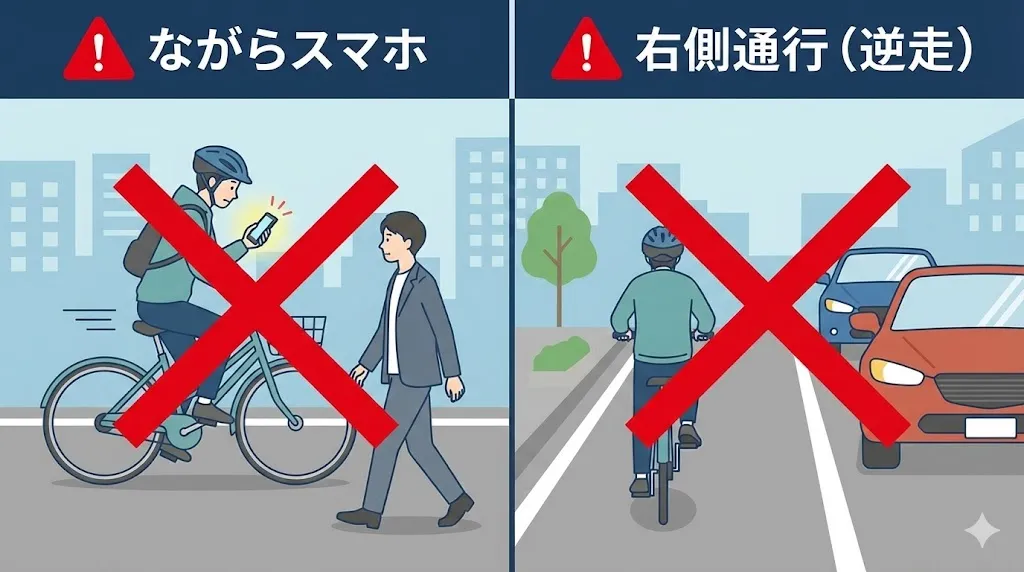
Particular attention is required for “Wrong-way cycling on the road (right-side traffic)” and “Smartphone use.” These are currently priority enforcement items, and cases of immediate apprehension due to witnessing at intersections are increasing. Reaching two crackdowns within a three-year period is easily achieved through an accumulation of daily “carelessness,” so constant reconfirmation of rules is required.
4. Mechanism and Cost of the Bicycle Driver Safety Course
ミントちゃん- Course Duration
3 hours (Watching videos, aptitude tests, writing an essay, etc.)
- Course Fee
6,150 yen (Standard amount)
- Attendance Deadline
Within 3 months from the issuance of the order
5. Is There a Possibility the Company Will Find Out? Social Impact of Criminal Penalties
 生活リスクポイント
The biggest risk for an office worker is not the fine itself, but the “criminal record” and “disclosure to the workplace.” Once a fine is finalized, it is recorded in the municipality’s “Register of Criminals” and managed for a certain period.
The Reality of “Workplace Disclosure” Shown by This Case
- Police Workplace Visits: In the Osaka case, the police visited the workplace to issue reminders. At this point, the company will become suspicious and ask for an explanation of the situation.
- Real Name Coverage / Digital Tattoo: If you are referred to prosecutors and it is reported, records will remain on the internet.
- Qualification Restrictions: For some national qualifications and occupations, a fine (criminal record) may lead to disadvantages such as suspension of qualifications.
If the employment rules include an obligation to report criminal penalties, concealment itself could become grounds for dismissal. This is an all-too-expensive price to pay for a cost that could have been avoided just by taking a 6,150 yen course within three months.
6. Frequently Asked Questions (FAQ)
- I haven’t been apprehended yet, but is there anything I should do?
The most important thing is to understand the “16 types of dangerous acts” and eliminate them from your daily driving. In particular, failing to stop at stop signs and wrong-way cycling (right-side traffic) are priority items for police enforcement, and there is a risk of receiving a “first apprehension” without even realizing it.
- If I have bicycle insurance, will the fine or safety course be waived?
No. Insurance covers “compensation to the other party (civil),” but it does not cover “fines or courses (criminal/administrative)” due to traffic violations. However, it is essential equipment to prevent economic ruin in the event of an accident.
- If the police come to my workplace after I ignore the safety course notice, can I refuse?
Police reminders are carried out lawfully as an administrative procedure. If you refuse to respond at the workplace, it will be judged that your “maliciousness” is even higher, leading to an earlier criminal referral. The only way to avoid this is to promptly show your intention to attend without refusing.
Summary: The Basis of Self-Defense is Not Paying the Price of “Ignorance”
The criminal referral on February 12, 2026, is a decisive turning point in an era where bicycle users are held to the same legal responsibility as automobile drivers as “vehicle operators.” The persistence of the police in issuing reminders, even by visiting the workplace, is a strong message that they will no longer allow anyone to “get away with it.” What we should take is not a reactive measure, but a “survival strategy” to prevent it beforehand.
【Prevention】Points for Risk Self-Defense
- Thorough Elimination of 16 Types: In addition to “distracted cycling” and “ignoring signals,” eliminate failing to stop from your habits.
- Take the “First Time” Seriously: Once you receive a guidance warning ticket or a red ticket, you are already on the Public Safety Commission’s list.
- Have the Shield of Insurance: In preparation for “compensation in the tens of millions,” which is even scarier than criminal penalties in the event of an accident, check your insurance.
Actions You Should Take Right Now (Survival Action)
Check Your Bicycle Insurance Status: If you are not enrolled, join immediately. Also, look back on whether you have received guidance warnings from the police in the past.
Re-identify “Stop” Locations on Your Commute: Abandon the complacency that “it’s okay because there are no police around.”
Bicycle Maintenance and Helmet Introduction: Complete your equipment with brake checks to prevent apprehension for “defective braking system” and gear that protects your life.
Reference Links
System / Primary Information
- National Police Agency: Overview of the Bicycle Driver Safety Course System
- e-Gov: Road Traffic Act (Article 120, etc.)





コメント