


“No water comes out even when I turn the tap,” “I don’t know when it will be restored.”
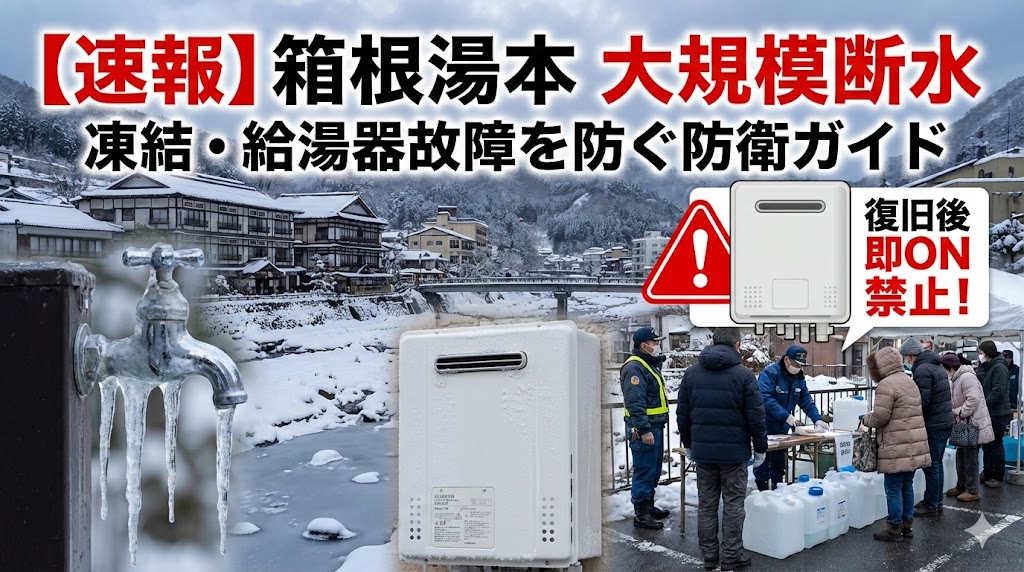
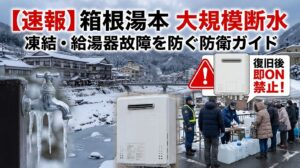
In early February 2026, a record-breaking cold wave (based on Japan Meteorological Agency observations) recorded a minimum temperature of -4.9°C in Hakone Town on February 8th. The resulting frozen pipes and leaks caused a water outage for approximately 1,300 households in the Hakone Yumoto area (excluding the Sukumogawa and Hatajuku districts), with nightly planned outages still ongoing.
What is particularly alarming is the “secondary failure” of water heaters that occurs when users rush to operate them the moment water is restored.
In this article, we explain the structural causes of this incident as a news report, while providing survival actions for the ongoing outage and audit-level defense techniques to protect your water heater and your wallet.
Conclusion: The “Water Flow Procedure” immediately after restoration protects your assets
Even if water starts flowing, do not turn on the water heater immediately. Always run “water only” until it is clear to discharge mud and air from the pipes before using the appliance.
Chapter 1: [News Explanation] Why did a large-scale water outage occur in Hakone?
 クロマル
クロマルIt wasn’t just a simple malfunction. It was a compound disaster where a “record cold wave” met the “unique structure of a tourist destination.”
Mechanism: How -4.9°C led to “Depletion of Distribution Reservoirs”
Observations in Hakone Town recorded a minimum temperature of -4.9°C on February 8, 2026 (based on Japan Meteorological Agency data).
Normally, water in pipes freezes at around 0°C and poses a risk of bursting when it expands. However, it is reported that pipe burst incidents increase rapidly under extremely low temperatures below -4°C to -5°C.
The direct cause of this water outage was the following chain reaction (domino effect):
- Intense Cold Wave: Water inside the pipes freezes and expands, causing the pipes to burst.
- Widespread Leaks: Leaks are left unattended, particularly in vacant houses and villas where owners are absent.
- Collapse of Supply Balance: The amount of water leaking from burst locations exceeds the amount of water produced by the purification plant.
- Depletion of Reservoirs: The tanks that store water for the community (distribution reservoirs) run empty, causing a widespread loss of water supply.
Hakone Town is currently prioritizing the filling of reservoirs by implementing nightly planned outages. However, it is expected that a full return to normal supply will take time until the leak locations are identified and repaired.
*Past observation data can be confirmed on the Japan Meteorological Agency official website.
[Latest as of 2/11] Current Water Supply and Planned Outage Schedule
As of February 11, operations are being conducted according to the following schedule. Nightly planned outages are expected to continue for the time being, making long-term preparation essential.
- Planned Outage: 12:00 AM – 5:00 AM (Scheduled to continue for the time being to recover reservoir levels; please check the latest HP).
- Water Supply Station Hours: Morning to Afternoon (e.g., from around 7:00 AM to evening; varies by station. Please check the Hakone Town HP for details).
Contact Information: Hakone Town Water, Sewerage, and Hot Spring Division: 0460-85-9569 / 0460-85-9567
Emergency Water Supply Stations in Operation (4 Locations)
- In front of the Hakone Town Hall Branch Office
- Yumoto Elementary School Playground
- Yamasaki Community Center Parking Lot
- Site of the Old Tourist Souvenir Hall
*Please check the Hakone Town official website for detailed maps and the latest information.
Chapter 2: [Important] Avoid the “Water Heater Trap” immediately after restoration
クロマルThis is the point of maximum potential loss. Rushing to turn it on can result in repair costs of tens of thousands of yen.
Why is “Instant Hot Water” dangerous?
Immediately after water restoration, the pipes contain dislodged rust, mud, and a significant amount of air.
If you attempt to run hot water through the heater in this state, the internal filter (strainer) will clog immediately, or the pump may fail due to “air lock.”
The correct restoration procedure taught by pros
Hakone Town has warned of the risk of turbid water immediately after restoration, and water heater manufacturers (following manuals from Noritz, Rinnai, etc.) also recommend “running water only until it is clear before using the water heater.”
- Keep the water heater remote “OFF.”
- Open a faucet (a single cold water tap is recommended) in the kitchen or bathroom and run “water only.”
- Initially, brown water and air will come out violently, but keep it running for approximately several minutes to 10 minutes as a guide.
- Once you confirm the water is transparent and the air (gurgling sound) has subsided, turn on the water heater power for the first time.
Chapter 3: “Fair Prices” and “Contractor Audits” for Frozen or Burst Pipes
クロマルPanicked consumers are easy targets for unscrupulous contractors. First, get a quote from a designated contractor.
Guide to Repair Costs and Contractor Selection
As a general guide for plumbing contractors, minor work such as thawing frozen pipes is often handled relatively cheaply, whereas replacing pipes inside walls/underground or replacing water heater parts tends to be expensive.
| Work Details | Estimated Cost (Yen) | Notes |
|---|---|---|
| Thawing (Electric thawing, etc.) | 10,000 – 25,000 | For minor cases (Guideline only) |
| Pipe Replacement (Exposed) | 20,000 – 40,000 | Per location |
| Pipe Replacement (Internal/Buried) | 50,000 – | Excluding wall opening/restoration costs |
| Water Heater Part Replacement | 50,000 – 100,000 | In case of circuit board/pump failure |
*The above amounts are estimates showing general market price ranges. Actual construction costs vary depending on the extent of damage and the contractor.
The Absolute Defense Line for Choosing a Contractor
Always choose a “Designated Water Supply System Construction Contractor.”
These are businesses designated by the local government as having appropriate technology and equipment based on the “Water Supply Act” of the Ministry of Health, Labour and Welfare.
It is a cardinal rule to check the list of designated contractors on the local government website and obtain quotes from multiple contractors whenever possible.
Chapter 4: [Household Defense] Are Accommodation Cancellations due to Water Outages Refundable?
クロマルTo travelers: Don’t just give up. Ask for a legitimate explanation.
Contract Cancellation and Negotiation due to “Force Majeure”
A water outage in an accommodation facility is a serious defect affecting the core of the service.
In the standard interpretation of travel agency terms and conditions, if provision becomes impossible due to “force majeure” such as natural disasters or infrastructure failure, cases often permit partial or full waiver of cancellation fees or alternative measures (such as rescheduling).
However, the final response depends on the contract and judgment of the accommodation or travel agency.
To avoid being processed as a “personal convenience” cancellation, explain the circumstances to the facility and request a reasonable response in light of the purpose of the Consumer Contract Act (the spirit of avoiding unfair disadvantage). In case of trouble, we recommend consulting the National Consumer Affairs Center of Japan.
[Column] Infrastructure Audit Office View: “Vulnerability of Tourist Destinations” and Our Self-Defense
This water outage in Hakone is not just a natural disaster; it highlights the structural risks faced by tourist destinations across Japan.
1. “Empty Houses” Destroy Infrastructure
In villa areas and tourist spots like Hakone, there are many buildings that become unoccupied during the winter.
If residents were present, they could operate anti-freeze heaters or drain the pipes, but measures tend to be neglected in vacant buildings.
As a result, pipes burst without anyone noticing, and precious local water continues to flow out from there, emptying the distribution reservoirs for the entire town.
2. The Cost of the “I’m Fine” Mentality
The baseless reassurance that “it’s Kanto, so it won’t get that cold” becomes a fatal wound the moment the temperature crosses the -4°C threshold.
Infrastructure is connected. We must re-recognize that one household’s negligence (lack of preparation) can be the first domino that threatens the life of the entire community.
3. What We Should Do for the Future
Instead of leaving everything to the administration, let’s be thorough with the following “self-defense”:
- Travelers: Anticipate “water outage risks” during winter travel and take self-defense measures such as bringing bottled water.
- Property Owners: Take responsibility for “draining water” when absent or outsourcing freeze protection measures to a management company.
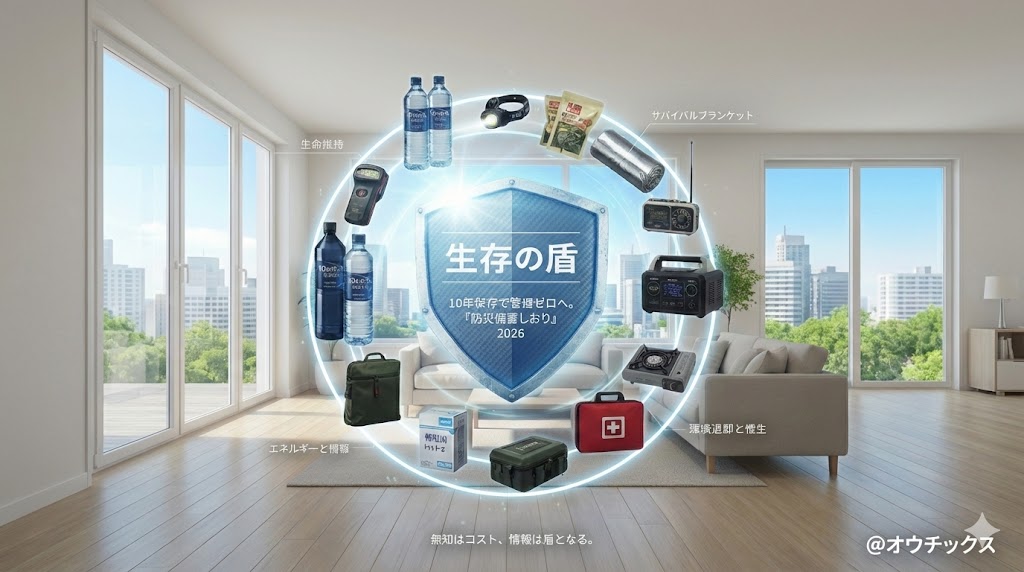
- Residents: Recognize that “3 days’ worth of drinking water (9 liters per person)” is essential equipment not only for earthquakes but also for cold wave preparation.
Frequently Asked Questions (FAQ)
- Q. When will the water be safe to drink?
- A. Immediately after water supply is resumed, there is a risk of occasional turbidity. It is recommended to wait until the water is transparent and start using newly stored water. If you are very concerned, you can use it after boiling it once just in case.
- Q. Is it okay to flush the toilet?
- A. If you use the water in the tank during an outage, you won’t be able to flush it next time. Respond by pouring water (approx. 6–8 liters) directly into the toilet bowl using a bucket or similar container. For tankless models, caution is required as some require power.
- Q. How long should I keep the anti-freeze heater on?
- A. It is recommended to keep it powered on during periods when temperatures are likely to be at or near freezing. However, unnecessary long-term operation or covering with materials can cause fires, so be sure to check the safety precautions in the instruction manual.
Summary: Information saves lives as much as “water” does
Key Points for Risk Avoidance
- After restoration, run “water only” until it is transparent.
- Turn ON the water heater power at the very end.
- Limit repair requests to “municipally designated contractors.”
Actions to Take Next
- Turn OFF your home’s water heater power.
- Secure a water container or clean vessel for water supply.
- Check the latest water supply station map on the Hakone Town official website.
Reference and Related Links
- Hakone Town Official Website ( [Important] Information on Water Outages in the Town)
- Japan Meteorological Agency (Past Weather Data and Warnings)
- Ministry of Health, Labour and Welfare (Water Supply Act / Designated Water Supply System Construction Contractor System)
- Kanagawa Prefecture (Water Safety and Designated Contractor Information, etc.)
- National Consumer Affairs Center of Japan (Awareness of Plumbing Repair Troubles)
- Japan Tourism Agency (Standard Travel Agency Terms and Conditions)


Comments