“I’m safe now because I bought a disaster preparedness kit online”—if you think that, your complacency might be your most dangerous “vulnerability.” From my perspective as someone on the front lines of infrastructure maintenance at a major gas company and a survivor of the Great East Japan Earthquake, many commercially available sets lack the practical viewpoint of “will it actually work in an extreme state?” or “can it withstand a grueling week?” The gap in information directly correlates to the gap in survival rates. That is the cruel reality of a disaster site.
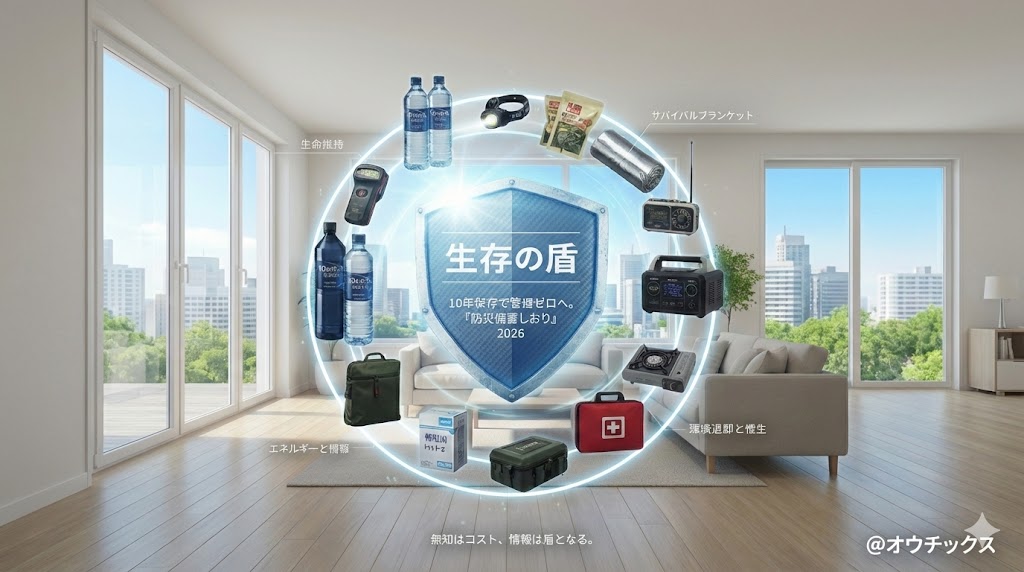
In this article, the Ouchix Research Lab thoroughly explains 12 items carefully selected based on the cold auditing standard of “survival strategy.” We will delve into what specific risks each piece of equipment physically averts and why it serves as the final seawall protecting your life and the lives of your family. Etch these “engineering and practical grounds” into your brain as a shield for your intellect. Ignorance is a cost, and information is the strongest armor.
[Phase 1: Life Support] The “5 Shields” to Break Through the First 72 Hours
 クロマル
クロマル1. 10-Year Shelf-Life Water (Drinking Water)
【What is Needed】
Ultra-long-term storage drinking water with a minimum baseline of 3L per person per day, with impurities removed to the limit and sealed in special multi-layered bottles with excellent heat and pressure resistance.
【Why it is Needed】Pro Perspective
An adult’s body is roughly 60% water; losing just 2% can lead to impaired consciousness and severe dehydration symptoms. Survival without hydration has a physical limit of “3 days.” As the Noto Peninsula Earthquake demonstrated, restoring water infrastructure can take months. During that time, standing in line for hours at a water truck for heavy water significantly drains physical and mental strength and lowers immunity. “Cheap water” that expires in 2 or 5 years not only creates “hidden economic losses” in replacement effort and disposal waste but also leads to “out-of-stock risk” due to expiration when it’s truly needed. 10-year shelf-life water is a wise investment to reduce this management burden (effort and cost) by more than half and always maintain “100% drinkable stock.”

 ポチップ
ポチップ
2. Emergency Food (Long-term Storage Food)
【What is Needed】
Alpha rice (pre-gelatinized rice) that can be eaten just by adding hot or cold water, and canned goods for 5+ years of long-term storage that are rich in meat and vegetables and can provide immediate energy upon opening. Whenever possible, select items with flavors close to what you are used to eating regularly.
【Why it is Needed】Pro Perspective
Hunger in extreme conditions is not merely physical starvation. When the supply of carbohydrates to the brain is cut off, humans lose their ability to make calm judgments, and mental collapse—such as irritability and feelings of despair over trivial matters—begins. Alpha rice, which requires no fire and minimal water for preparation (about 160ml), is a vital fuel that supports the “sustained combat capability” of sheltering at home. Furthermore, “tactical stock” that provides familiar flavors goes beyond simple nutrition to bring a powerful form of mental care called “a sense of security” into a devastated, extraordinary environment, warding off the risk of disaster-related death.
 ポチップ
ポチップ
3. Portable Water Purifier
【What is Needed】
A high-performance straw-type or pump-style portable water purifier capable of removing 99.9% or more of bacteria, protozoa, and microorganisms (recommended filter precision of around 0.1 microns).
【Why it is Needed】Pro Perspective
No matter how much water you stockpile, if the evacuation period lasts longer than expected, you will eventually reach the “bottom of your stock.” A purifier that turns bathtub water, rainwater, or nearby well water into potable water is the ultimate insurance to prevent “running out of supplies.” In mountainous areas where infrastructure restoration is delayed or regions with isolation risks, having a means to block pathogens with a physical filter and secure a water source becomes a critical factor determining survival continuity. Drinking unsanitary water as-is is a suicidal act that leads to death by dehydration from severe diarrhea.
 ポチップ
ポチップ
4. Battery-Powered Headlight
【What is Needed】
A head-mounted light powered by high-performance dry batteries (such as Evolta) with high waterproof performance (IPX class) that works even in violent tremors or flooded environments, and a light output in the 5000-lumen class to see every corner of the field of vision.
【Why it is Needed】Pro Perspective
Large earthquakes often strike at night, accompanied by deep darkness. In a room with no power or a hallway cluttered with scattered furniture, “having both hands free” is an absolute defensive line to prevent secondary injuries. With a handheld flashlight, you cannot protect yourself during a fall amidst rubble, nor can you protect children or the elderly, or evacuate cautiously by feeling the walls. A smartphone light is only for emergencies; wasting the battery of your smartphone—your lifeline for information—for “light” is a folly equivalent to throwing away your right to request rescue. Keeping your hands free at all times leads to securing a survival space.
 ポチップ
ポチップ
5. Emergency Blanket (High-Strength, Low-Noise Type)
【What is Needed】
An aluminum-vaporized polyester sheet that reflects up to 90% of infrared heat radiated from the human body and blocks wind and rain, preventing body heat loss through radiative cooling.
【Why it is Needed】Pro Perspective
During a disaster, even if it’s not winter, people can find themselves on the brink of a silent death from “hypothermia” on summer nights or during evacuation while wet from rain. This sheet reflects your own heat like a mirror, keeping you warm like a “thermos” without consuming any fuel. High-quality products have excellent noise reduction, minimizing the risk of causing trouble with others in crowded shelters due to rustling sounds, and securing the quality of sleep to prevent physical and mental exhaustion. This thin, light sheet becomes the strongest shelter on a freezing night.
 ポチップ
ポチップ
[Phase 2: Energy and Information] The “3 Shields” to Prevent Isolation
クロマル6. Emergency Radio (Supercapacitor Type)
【What is Needed】
A hand-crank charging radio that uses a “supercapacitor (electric double-layer capacitor)” to physically store electricity rather than general rechargeable batteries (like lithium), ensuring the storage function doesn’t degrade even if left for 10 years.
【Why it is Needed】Pro Perspective
The internal batteries of many cheap emergency radios die chemically after being left for a few years, turning into “trash” that won’t charge or produce sound even when cranked in an emergency. What is truly needed during a disaster is “physical reliability”—the ability to take it out after 10 years and reliably hear the news. Grasping primary information broadcast by the NHK or local governments, without being misled by false information (hoaxes) on social media, is the only way to avoid making the wrong survival decisions. Information cutoff means “social death” in the modern age.
 ポチップ
ポチップ
7. Portable Power Station
【What is Needed】
A large-capacity lithium iron phosphate (LiFePO4) battery of 500Wh or more, equipped with a pure sine wave AC output to run household appliances and capable of fully charging a smartphone dozens of times.
【Why it is Needed】Pro Perspective
A palm-sized mobile battery is barely enough to maintain a smartphone. However, with a portable power station, you can run electric fans, electric blankets, rice cookers, and even medical nebulizers. Especially during evacuation in extreme heat or bitter cold, this “autonomous electricity” becomes a life-saving source of heat or cooling. It is a modern-day infrastructure self-defense base that goes beyond maintaining communication means to physically enabling “temperature management” in your living space. When combined with solar panels, you can maintain a survival environment even during long-term isolation.
 ポチップ
ポチップ
 ポチップ
ポチップ
8. Cassette Stove and Gas Canisters
【What is Needed】
A stove with a windproof structure, such as a double windshield, to withstand outdoor winds, and a minimum of 3 to 6 JIS-standard genuine gas canisters per person per week.
【Why it is Needed】Pro Perspective
Restoring city gas is the slowest among lifelines, typically taking over a month in a large-scale disaster. Consuming even a single bite of a warm meal is medically indispensable for raising internal body temperature and keeping autoimmune functions normal. A cassette stove becomes “the only controllable heat source” during a power outage, supporting the core quality of life by boiling water for sterilization, making formula for infants, and warming a chilled body from the inside out. Stock management of gas canisters (rolling stock) is a strategic material that literally maintains the temperature of your life.
 ポチップ
ポチップ
[Phase 3: Environmental Adaptation and Hygiene] The “4 Shields” to Prevent Disease and Panic
クロマル
9. Portable Toilet (Coagulant + Odor-Proof Bag)
【What is Needed】
A set containing a powerful absorbent coagulant that solidifies liquid in seconds and specialized bags with medical-level odor-blocking performance (such as BOS), with a stock of 7 uses per person per day for at least one week.
【Why it is Needed】Pro Perspective
If you force a toilet flush during a water or power outage, damaged pipes can cause “excrement backflow and leakage accidents” throughout an entire apartment building, turning your home into an uninhabitable biohazard zone. An environment where excrement is not properly processed becomes a hotbed for mass infections by norovirus or E. coli. Portable toilets that can physically isolate and seal waste are the top priority for maintaining dignity during home evacuation. The intense stress of “odor” and “filth” is the biggest trigger that numbs human reason and induces panic.
 ポチップ
ポチップ
 ポチップ
ポチップ
10. First Aid Kit (Medical Kit)
【What is Needed】
A high-visibility red or orange storage kit containing powerful hemostatic pads, bandages of various sizes, disinfectant, elastic bandages, fever/pain relievers, tweezers, and surgical tape.
【Why it is Needed】Pro Perspective
During a large-scale disaster, local hospitals will be overwhelmed with the seriously injured, and a “medical collapse” where one cannot even be seen for minor trauma or fever will certainly occur. Whether or not you can perform initial first aid by yourself is the decisive boundary to prevent small wounds from leading to tetanus or suppuration, or a health deterioration in an unfamiliar environment from leading to “disaster-related death.” Preparation as a “mobile mini-clinic” to protect yourself and your family is also the strongest tranquilizer in extreme conditions.
 ポチップ
ポチップ
11. Laundry Bag (Waterproof Washing Bag)
【What is Needed】
A roll-top waterproof bag, such as the Scrubba Wash Bag, featuring internal silicone nubs that allow for sealed washing and drying of clothes with a small amount of water (3–5L).
【Why it is Needed】Pro Perspective
When evacuation life exceeds one week, many people face the unbearable discomfort and risk of skin diseases (heat rash, infections) caused by “dirty underwear and socks.” In water-deprived conditions where washing machines cannot be used, having a means to “wash efficiently with limited water without getting your hands dirty” is extremely effective not only for maintaining hygiene but also for regaining a “sense of daily cleanliness” and preventing mental decay. When not in use, it is a multi-functional hygiene strategic piece of equipment that serves as a bucket for transporting water or a protective bag for electronic devices you absolutely don’t want to get wet.
 ポチップ
ポチップ
12. Fireproof Case / Safety Bag
【What is Needed】
A dedicated bag made of special materials such as silicone-coated fiberglass to protect property deeds, bankbooks, contracts, and identification from the heat of flames near 1000 degrees and the powerful water discharge during firefighting activities.
【Why it is Needed】Pro Perspective
Immediately after your life is saved, you will embark on the next long-term battle called “rebuilding your life.” At that time, whether or not you physically have property deeds, bankbooks, and family registers in hand will radically change the speed of public assistance procedures and your ability to recover assets by several months. Even if you lose your home in an accidental fire, you must increase the possibility—even by 1%—of recovering your “ticket to revival” unscathed from the ashes. This is the final line of defense to protect not only your physical assets but also the hope that “you can start over.”

Summary: Complete Your “Survival Guide” Right Now
The 12 items introduced here are by no means just a list of “convenient outdoor goods.” Each plays an independent role while fitting together like puzzle pieces to complete the “rampart” that physically protects your precious daily life. If you feel it’s difficult to get everything at once, start this very moment with the three points directly linked to life support: “Drinking Water, Emergency Food, and Portable Toilets.” That one step to fill the information asymmetry will be the decisive turning point that connects the lives of you and your family several years from now.
| Priority | Defense Phase | Shields to Secure First |
|---|---|---|
| SS (Immediate Death Avoidance) | Prevent physical accidents and initial injuries | Headlight, First aid kit, Furniture anchoring (seismic dampers, etc.) |
| S (The 3-Day Wall) | Maintain minimum physiological life activities | 10-year shelf-life water, Emergency food, Portable water purifier, Blanket |
| A (The 1-Week Wall) | Prevent secondary damage, social isolation, and hygiene collapse | Portable toilet, Emergency radio, Portable power station, Stove, Laundry bag |
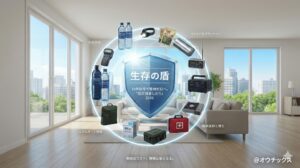
【Shield of Survival】12 Disaster Preparedness Items Pro Audit List
Essential equipment for “physical survival” selected by major infrastructure company employees
This list is created based on an auditing standard of whether items will physically function in extreme states, not just “whether you have them.” The quality (specs) of your stockpile will determine your survival rate.
| Category | Item Name | Recommended Specs / Quantity | Audit Point (Check here!) |
|---|---|---|---|
|
I. Life Support (Onset ~ 72 Hours) |
1. 10-Year Shelf-Life Water | 3L per person per day × 7 days | |
| 2. Emergency Food | 3 meals per person per day × 7 days | ||
| 3. Portable Water Purifier | 1 or more per household | ||
| 4. Headlight | 1 per person (for each family member) | ||
| 5. First Aid Kit | 1 per household | ||
|
II. Energy & Information |
6. Emergency Radio | 1 per household | |
| 7. Portable Power Station | 500Wh ~ 1000Wh | ||
| 8. Cassette Stove | 1 unit + 1 week’s worth of canisters | ||
|
III. Environment, Hygiene & Recovery |
9. Portable Toilet | 7 uses per person per day × 7 days | |
| 10. Laundry Bag | 1 ~ 2 per household | ||
| 11. Emergency Blanket | 1 per person | ||
| 12. Fireproof Case | 1 per household |
Reference Links:


コメント